Why the material decision matters more than the design
Most buyers spend weeks refining a bag design and only minutes choosing the material. That order is backwards. The material determines the hand feel your customer notices first, how the bag survives a year of daily use, which printing methods are available, and whether your landed cost fits your target retail price. Choosing the wrong substrate is the single most expensive mistake in custom bag sourcing, because it usually only becomes visible after mass production has started.
This guide walks through the five materials used most often in OEM bag production, what each one is genuinely good at, and the specification details you should confirm before your factory cuts the first panel.
PU synthetic leather: the default choice for fashion and business bags
PU (polyurethane) leather is a fabric base coated with a polyurethane layer. It is the workhorse material for laptop bags, briefcases, handbags and promotional totes because it accepts embossing, debossing, screen printing and hot stamping, and it can imitate the grain and drape of real leather at a fraction of the cost.
- Strengths: wide colour range, soft hand feel, easy to emboss a logo, water-resistant surface, consistent quality between batches
- Limitations: cheaper PU can peel or crack at fold lines after 12–18 months of heavy use, so coating thickness and backing quality matter enormously
- Best for: business bags, laptop bags, fashion totes, corporate gifts
When specifying PU, always ask for the backing type (knit, woven or non-woven) and the coating thickness in microns. A 0.6 mm PU with a knit backing behaves completely differently from a 1.0 mm PU with a woven backing, even though both are quoted as "PU leather".
PVC: maximum water resistance at the lowest cost
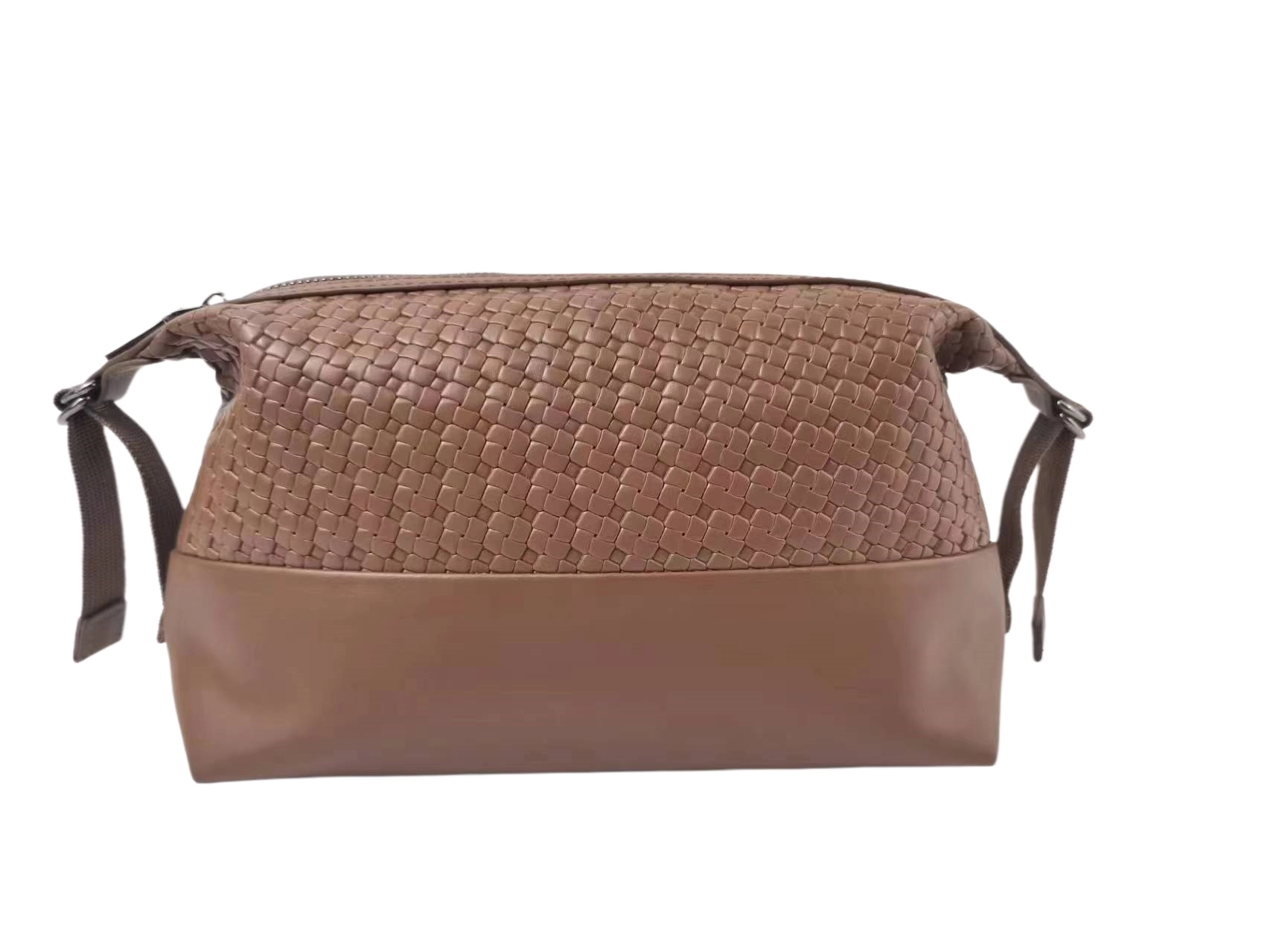
PVC (polyvinyl chloride) is a heavier, more rigid material with excellent water resistance and a glossy or matte finish. It is widely used for cosmetic bags, toiletry bags, cooler bags and utility products.
- Strengths: fully waterproof, very durable against abrasion, low material cost, easy to wipe clean
- Limitations: stiffer hand feel, heavier weight, increasing regulatory pressure in the EU because of phthalate restrictions, harder to recycle
- Best for: toiletry bags, cosmetic pouches, waterproof utility bags, promotional items
If your market is the European Union, confirm that the PVC formulation is phthalate-free and request the relevant test report before production. This is not optional for mass retail.
Nylon and polyester: the technical choice for backpacks and travel bags
Nylon and polyester are woven fabrics, usually specified by denier (D). A 210D fabric is light and packable; 600D is the standard for backpacks; 1680D is heavy-duty and abrasion-resistant. Both can be coated with PU or PVC on the reverse side for water resistance, and both accept screen printing, sublimation and embroidery.
- Nylon: higher tensile strength and better tear resistance than polyester at the same weight, softer hand feel, more expensive
- Polyester: excellent UV and colour-fastness performance, better dimensional stability, lower cost, the most common choice for backpacks and duffle bags
- Best for: backpacks, duffle bags, travel bags, sports and outdoor products
For backpacks, the fabric body is only half the story. Buyers should also specify the lining (210D polyester is standard), the webbing for straps (usually PP or nylon webbing), the zipper brand and type, and whether the base panel needs a reinforced 1680D layer to resist abrasion when the bag is set down.
Canvas and cotton: the sustainable, printable option
Cotton canvas in 10 oz, 12 oz or 16 oz is the standard material for tote bags, shopping bags and eco-oriented product lines. It is printable, foldable, reusable and biodegradable, which makes it a strong marketing choice for retail brands.
- Strengths: natural appearance, excellent for screen printing and digital transfer, strong sustainability story, low tooling cost
- Limitations: not water-resistant unless waxed or coated, heavier shipping weight, colour consistency varies more between dye lots than synthetic materials
- Best for: tote bags, shopping bags, gift bags, sustainable collections
If sustainability is the reason you are choosing canvas, verify the certification: GOTS for organic cotton, or a recycled-content certificate such as GRS. Vague claims of "eco-friendly cotton" carry no value with retail buyers and can create compliance risk.
A practical comparison at a glance
Across these five materials, the trade-off follows a consistent pattern. PU offers the best balance of appearance, branding options and cost for structured bags. PVC wins on waterproofing and price but loses on sustainability and hand feel. Nylon and polyester win on strength and durability for load-bearing products. Canvas wins on eco-positioning and printability for light-duty totes. Higher-grade material almost always reduces total cost of ownership, because the labour cost of assembling a bag is fixed — a material failure wastes that labour entirely.
Frequently asked questions
Q: Which bag material lasts the longest?
A: For load-bearing bags, nylon and polyester in 600D or higher with a PU backing outlast coated fabrics in most daily-use conditions. For structured business bags, a 1.0 mm PU with a woven backing is the most durable coated option. The decisive factor is usually material grade within the category, not the category itself.
Q: What is the minimum order quantity for a custom material?
A: MOQ depends on whether the material is a stock colour or a custom-dyed or custom-embossed specification. Stock colours in PU, polyester and canvas typically start from a few hundred pieces, while a custom-developed PU grain or a custom-dyed canvas requires a mill minimum, which can be several thousand metres. Confirming this early avoids redesigning the bag later.
Q: Can I mix materials in one bag?
A: Yes, and it is often the best approach. A common and effective combination is polyester body, PU trim panels or handle, and a reinforced 1680D base. Mixing materials lets you put strength where the load is and appearance where the customer looks, at a lower total cost than using a premium material throughout.
Conclusion
Choose the material before you finalise the design, not after. Match PU to fashion and business bags, PVC to waterproof utility products, nylon and polyester to backpacks and travel bags, and canvas to sustainable totes. Always specify grade, backing, denier and certification rather than the material name alone, and request test reports for anything sold into regulated markets.
Guangzhou Liya Leather Co., Ltd. has manufactured backpacks, laptop bags, duffle bags and totes across these five material families since 1999. With ISO 9001 and BSCI certification, a 10,000 sqm factory and more than 100 skilled workers, the company supports material selection, sampling and volume production for buyers worldwide. Send us your design or reference sample to receive a material recommendation and quotation.
About the author
This guide was prepared by the engineering and sourcing team at Guangzhou Liya Leather Co., Ltd., a bag manufacturer established in 1999 and serving OEM and ODM customers in Europe, North America and Asia. The team handles material development, sampling and production planning for custom bag programmes. Contact us to discuss your next project.